BHRF software · Arizona
Software for Arizona behavioral health residential facilities
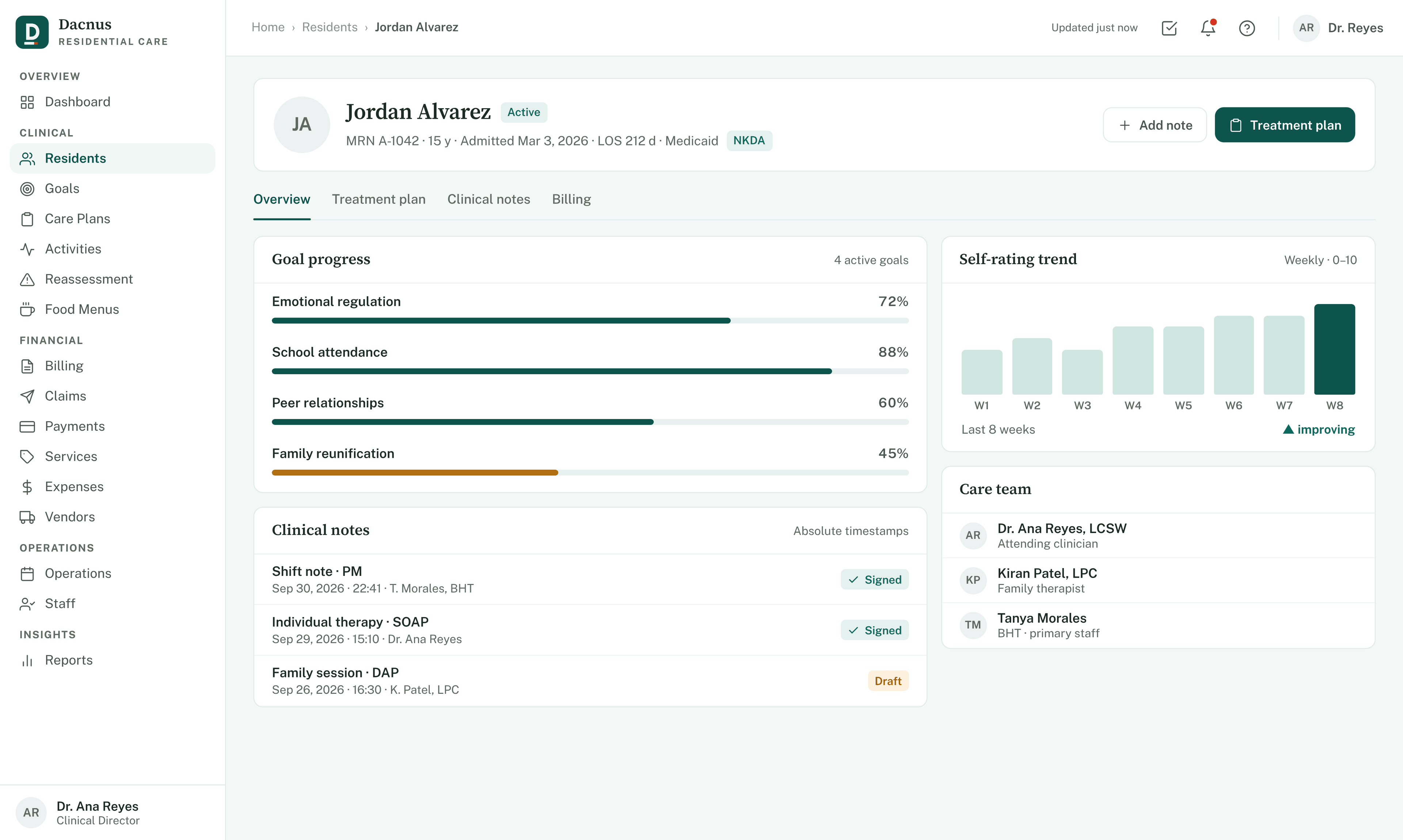
Dacnus was first built and proven inside a licensed Arizona residential program. It keeps treatment plans, shift notes, staff credentials, authorizations, and claims on one record, so the documentation a surveyor reads and the documentation a claim rests on are the same documentation your staff write every shift.
What an Arizona BHRF has to show
The rules, and where each one lives in Dacnus
ADHS licenses the facility under Article 7 of the health care institution rules, and AHCCCS sets the terms for every Medicaid stay. Each row links to the guide that explains the rule.
Assessments and treatment plans on the clock
Treatment plan before services or within 48 hours of the assessment, and a behavioral health professional's signature within 24 hours when a technician completes it (R9-10-707, R9-10-708).
The deadlinesIn Dacnus
Treatment plans with measurable objectives are signed and locked, with their version history kept, so it is clear which plan was in force and who signed it.
Clinical RecordsDocumentation behind every billed day
AHCCCS fee-for-service recertifications rest on the most recent seven consecutive days of notes, and continued stay requests on a current treatment plan.
Prior authorizationIn Dacnus
One shift note covers the house, with observations for each resident (mood, meals, sleep, and medications administered), signed each shift. Behavior logs record antecedent, behavior, and consequence.
Clinical RecordsStaff who are cleared to work
Fingerprint clearance cards, Adult Protective Services registry checks, CPR and first aid, and TB screening (A.R.S. 36-411, R9-10-706).
Staff requirementsIn Dacnus
Licenses, certifications, and training carry expiry dates, every expiring credential is on one screen, and each staff member's personnel file comes out as a single PDF.
ComplianceDrills on every shift
Disaster drills on each shift every three months and evacuation drills on each shift every six months, documented (R9-10-720).
Drills and safetyIn Dacnus
Task boards keep the day's work, such as a fire drill, visible to every shift until someone marks it done.
Operations & StaffAuthorizations that do not lapse quietly
Every BHRF stay needs prior and continued authorization, with continued stay requests due at least two weeks before the last authorized date (AMPM 320-V).
Prior authorizationIn Dacnus
Authorizations sit on the resident's record with their coverage, tracked by units approved, used, and remaining.
Intake & AdmissionsClaims AHCCCS will accept
H0018 per diem on the CMS-1500 or 837P, one line per date of service, place of service 56.
Claim rulesIn Dacnus
Claims export as a CMS-1500 PDF or an 837P file, one claim or a batch, and denials are logged with their appeal deadlines and outcomes.
Billing & PaymentsProof of who documented what
Medical record entries dated, legible, and authenticated, and kept for at least six years (R9-10-712, A.R.S. 12-2297).
Medical recordsIn Dacnus
Views and edits of resident and clinical records, and every signature, are written to an audit trail with who, what, and when.
Compliance
Built where the rules are written
Most behavioral health software is built for clinics and adapted for residential care. Dacnus went the other way: it was first built and proven inside a licensed Arizona residential program, around its shifts, its payers, and its licensing reviews.
BHRF is an Arizona license, but the level of care is not. If you run the same kind of program elsewhere, under a name like therapeutic group home or residential treatment, see therapeutic group homes and residential treatment programs. Dacnus is available to programs in every state, and our guide to residential licenses by state lists what each state calls this level of care.
Guides for Arizona BHRFs
- How to open a BHRF in Arizona: licensing requirements in plain languageThe ADHS license step by step, then the Article 7 rules on staff, assessments, treatment plans, discharge, drills, and records, each tied to its source.
- BHRF billing in Arizona: H0018, claims, and prior authorizationH0018 on the CMS-1500, place of service 56, what the per diem includes, prior authorization under AMPM 320-V, and AHCCCS timely filing limits.
- BHRF vs BHIF: how Arizona's residential behavioral health settings differBehavioral health residential facility, inpatient facility, sober living home, outpatient center, and DD group home: definitions and differences in one table.
- How to write group home shift notes, with a free templateWhat every shift note needs, eight weak notes rewritten, and a printable shift note template for group homes and BHRFs.
- ABC behavior log: how to fill one in, with a free templateAntecedent, behavior, consequence: how to record each one in a residential setting, worked examples, and a printable ABC log.
Questions BHRF operators ask
What is BHRF software?
Software that runs a behavioral health residential facility, sometimes called a BHRF EHR: the resident record (assessments, treatment plans, shift notes, and behavior logs), the 24/7 staff schedule, staff credentials and training, authorizations, and claims. Dacnus keeps all of these on one record.
Was Dacnus built for Arizona BHRFs?
Yes. Dacnus was first built and proven inside a licensed Arizona residential program, and its workflows were shaped by real daily operations, real payers, and real state licensing reviews.
Which claim formats does Dacnus produce?
CMS-1500 PDFs and 837P electronic claim files, for one claim or a batch. Those are the formats AHCCCS uses for BHRF claims.
We run several BHRFs. Can we see them together?
Yes. Organization, facility, and unit structure is built into the platform, with organization-wide reporting, and each resident keeps one record.
See your BHRF on one record
Bring your census, your shifts, and your payers. We'll walk through Dacnus with your program on screen.